Reducing the biological risk associated with salmon farming requires a clear focus on how long fish spend in the marine environment. From early on, we have worked systematically to optimize the production cycle, aiming to balance fish welfare, growth performance, and long-term sustainability.
Sea lice have been the industry’s greatest challenge for many years and have therefore acted as a catalyst for much of this work. We have placed strong emphasis on initiatives that enable us to control sea lice through prevention and structural improvements rather than increased treatment intensity.
Farming for a short time at sea is one of our most successful initiatives, resulting in fewer sea lice, faster salmon growth, and better health.
When salmon are harvested from a farm site, a fallow period follows. This rest period ensures that sea lice and other potential diseases disappear before smolt are stocked in pens again.
Our most trailblazing efforts in this area include the production of large, high-quality smolt on land and achieving rapid growth at sea. These, along with other initiatives, are discussed in more detail below.
High-quality smolt
The foundation for shortening the time salmon spend in the ocean is laid at our hatchery. Our staff have worked diligently to develop our smolt farming and quality. We have closely followed research in this area and have had the courage to try new solutions. This is clear when considering how well our salmon thrive and grow at sea.
Many things have contributed to this progress. One reason is that we have continuously searched for salmon roe that has the best inherited genetics. Additionally, it is imperative to have water of the highest quality. We have, among other things, made great efforts to keep the temperature low to ensure that the salmon grows to its full potential when placed in pens at sea.
Large smolt
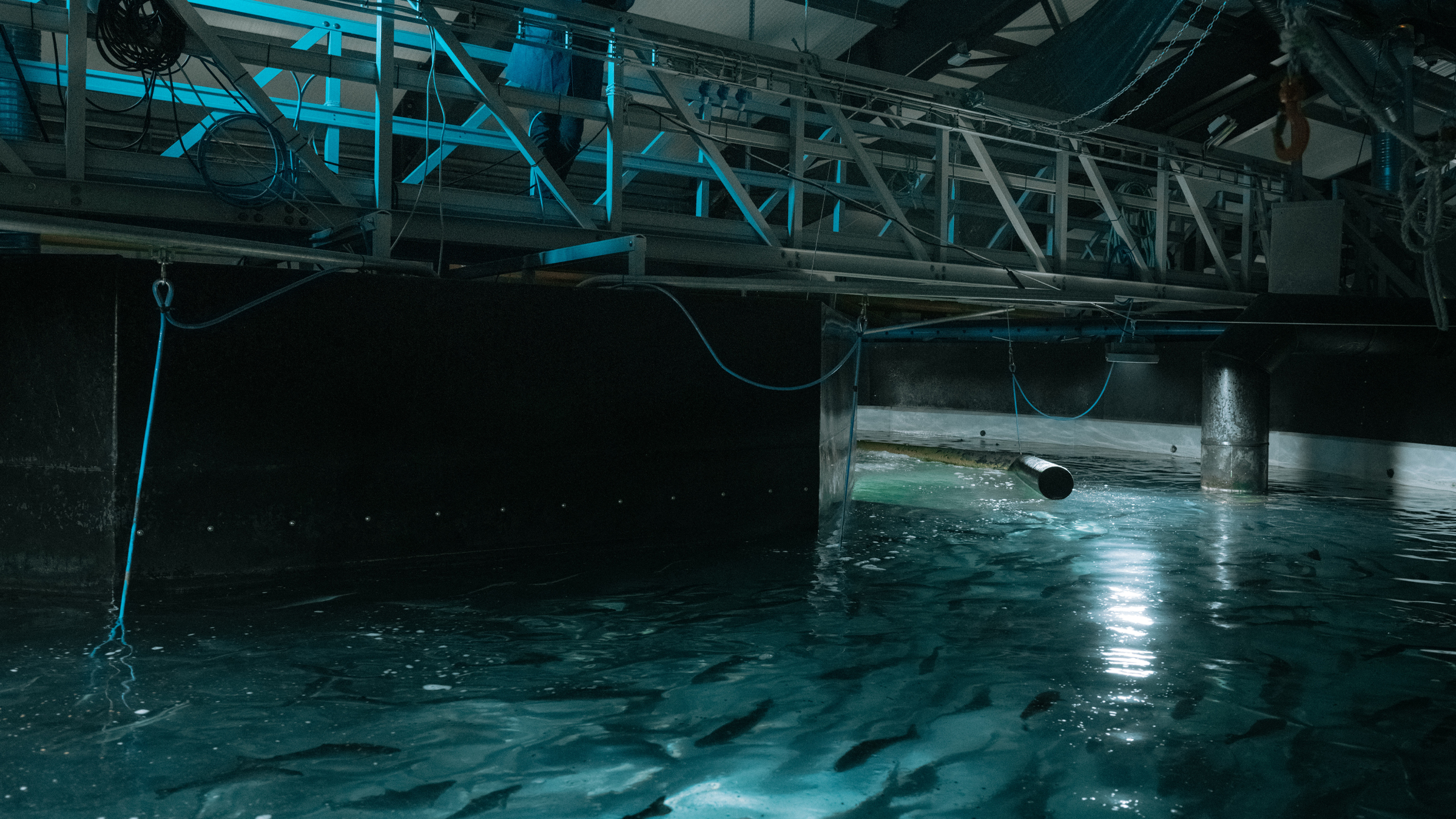
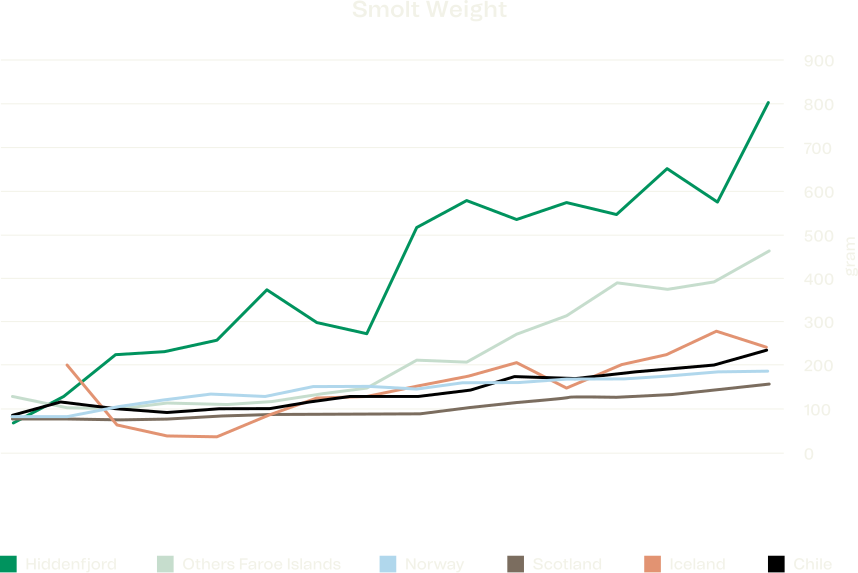
In 2010, Hiddenfjord became the first salmon farming company in the world to start producing smolt sizes that were previously non-existent. Expanding our smolt production at our Fútaklettur location was a big and risky investment, particularly because this was the first project of its kind. The decision to produce large smolt was made with the motive of fighting sea lice. The larger the smolt, the less time it needs to spend at sea, and, subsequently, there are fewer problems with sea lice and other biological challenges.
Our development of large smolt has drawn great interest from the global salmon farming industry. Farmers from all around the world have visited us at Hiddenfjord to learn about and draw experience from our work farming large smolts on land.
Rapid growth
It is imperative that salmon thrive and grow quickly to shorten the time spent at sea. This requires skilled and diligent employees.
Effective feeding plays a big role in salmon growth. The feeding method must ensure that each salmon is well-nourished as well as minimise feed waste.
Since the turn of the century, we have used cameras at all our fish sites. We can keep an eye on how the feeding process takes place from a feeding centre on land. Today, we use cameras and sensors under the sea surface in our pens to identify feed pellets and to control the feeding process. A sophisticated software system ensures that each salmon is adequately fed and that very little feed goes to waste. The technology was developed by the Faroese company, FaroeSea.
To ensure good living conditions for the salmon, Faroese authorities have set a pen density limit of 25 kg/m3. We strive to always have a pen density limit in each pen that is under 20 kg/m3. Also, we keep a close eye on the oxygen levels, which play a key role in animal welfare.
Our exposed farming sites, where sea currents provide a continuous flow of new water, ensure clean and good living conditions for salmon to grow and thrive.
Farming in areas with strong tidal currents
For many years, our dream has been to farm salmon in the sounds between the islands of the Faroe Islands, where we are sheltered from the powerful ocean waves and where enormous volumes of pristine water flow constantly through.
In close collaboration with a Faroese consulting company, we developed a current-taming system that makes it possible to farm salmon in areas with strong tidal currents. Since 2021, we have carried out extensive measurements, calculations, and modelling to determine how we can reduce the current enough to make salmon farming possible.
The result is a groundbreaking solution which, through skilled employees, expertise, and continuous adjustments, has proven that it is now possible to farm salmon in places where nature once set limits.
The strong and stable water exchange helps ensure excellent water quality for the salmon and a clean seabed beneath the pens. We are proud to be at the forefront of this development, which is attracting attention both in the Faroe Islands and abroad. We are confident that this technological innovation will be adopted at many sites in the future.