Salmon is a sustainable, healthy, and tasty food choice. It is the food of the future in a world with a rapidly growing population and an environment under pressure, where the selection of sustainable animal protein is very scarce.
Our commitment to sustainability is not just rhetoric; it's quantified. Independent research organizations in Norway have meticulously analyzed our carbon footprint across production, slaughter, and packaging in recent years. From 2023-2025, our emissions from production, slaughter, and packaging were just 3.4 kg CO2 per kg of HOG (head-on-gutted whole salmon). The independent research organizations attribute Hiddenfjord's lower carbon footprint to reduced fish mortality rates compared to the average for Norwegian salmon.
Beyond mere numbers, our ethos of sustainability reverberates throughout our practices. Air freight is a major contributor to global CO2 emissions and emits around 50 times as much CO2 as sea freight. We have prioritized low-emission transportation by eliminating air freight, slashing our carbon footprint from overseas transportation by 94%.
Choosing Hiddenfjord salmon isn't just choosing a fish; it's choosing a commitment to environmental preservation. Our core values mandate that we tread lightly on the environment, both locally and globally, ensuring that future generations inherit the same pristine conditions we enjoy today. This principle guides every aspect of our operations, from the pens where our salmon thrive to the feed they consume.
Raised in the Wild
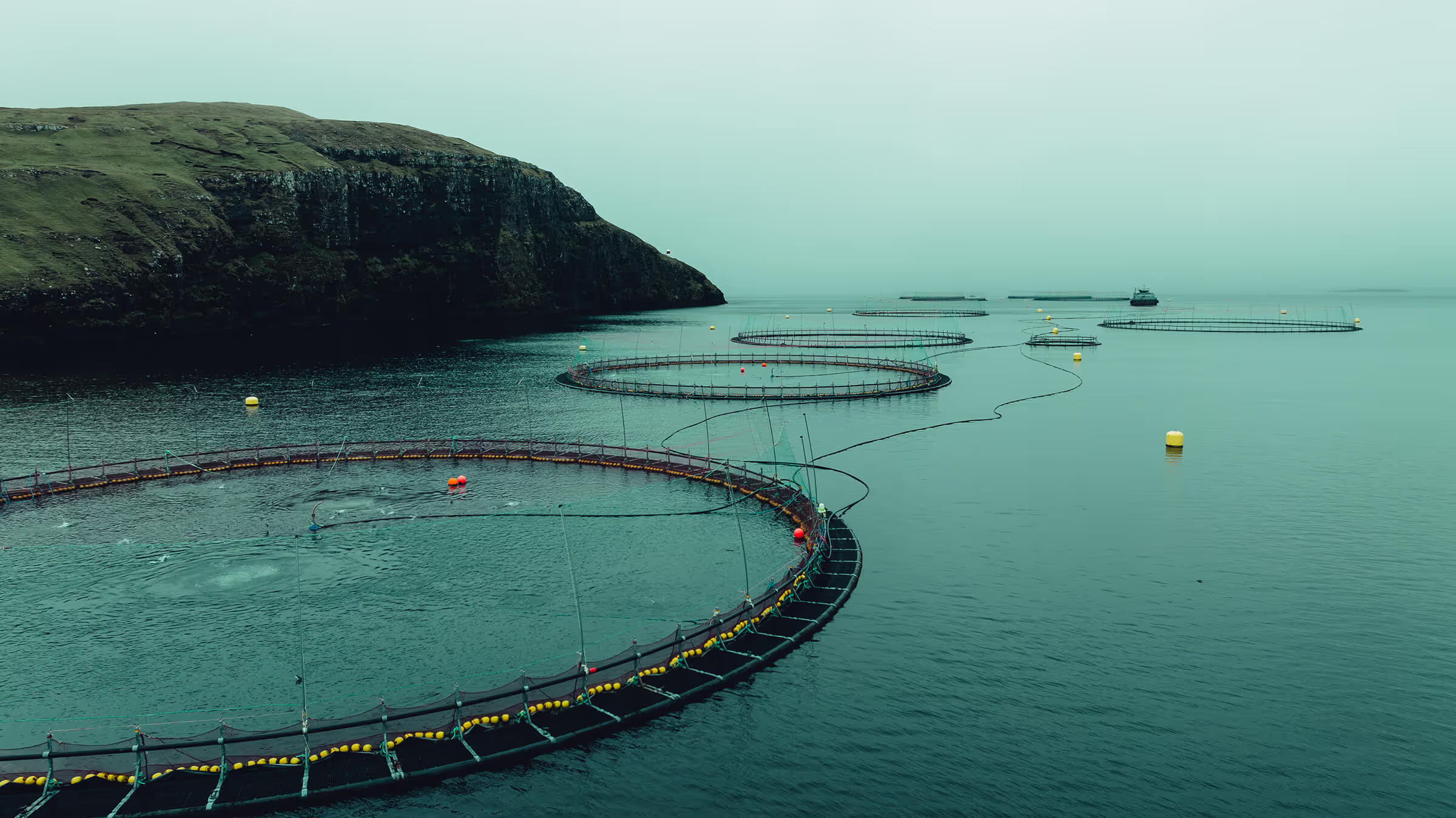
Hiddenfjord salmon is raised in pens placed in exposed sites to obtain optimal animal welfare and to prevent seabed pollution. We choose exposed locations to raise our salmon in order to secure the best living conditions for the salmon and the best environmental sustainability.
At Hiddenfjord, we regularly gather water quality and seabed measurements to ensure optimal farming conditions. To guarantee the quality of the seabed, the Faroese Environment Agency performs inspections of the seabed for every production cycle.
Efficient feeding
After air freight, feed is the biggest contributor to the carbon footprint of salmon production. Having a low feed conversion ratio (FCR) contributes to a lower carbon footprint. To ensure that exceptional events do not significantly affect the results, we report a feed conversion ratio (FCR) over a period of three years. From 2023-2025, our FCR was on average 1.17 kg feed to produce 1 kg of salmon.
We are a frontrunner in using innovative feeding systems with underwater cameras, sensors and software for detecting feed pellet distribution in the fish pens. The system is developed by Faroe Sea and is overseen by our feeding manager from our remote feeding central. The close and systematic monitoring of our feeding system has enabled the fish to reach its growth potential and helped us to reduce feed waste to an absolute minimum. Our experience clearly shows that the best living conditions for the salmon provide optimal growth and the very best taste and texture quality.
Pen space and fish welfare
Regulations require that the maximum density in the pens should not exceed 25 kg/m3. However, to enhance fish welfare and to ensure that our salmon have ample room to thrive and grow, we aim to have an internal max value set to 20 kg/m3 most of the time. We regularly gather oxygen measurements in order to secure optimal animal welfare. Our sustainable approach is a vital factor in ensuring our salmon’s welfare. As a result, we have some of the best survival rates in the industry. To ensure that exceptional events do not significantly affect the results, we report a mortality rate over a period of three years. From 2023-2025, our fish mortality rate was on average 8.3%, compared to a global industry average of around 15%.
Natural sea lice management
Sea lice, though a natural occurrence in wild salmon, pose a significant challenge for aquaculture. At Hiddenfjord, we've implemented a suite of sustainable strategies to combat this issue effectively.
Since 2010, we've made substantial investments in research aimed at enhancing the size of our freshwater salmon, known as smolt, before transferring them to sea pens. By increasing smolt size from an initial 80 grams to 800 grams, we've significantly reduced the duration of sea lice exposure. This pioneering approach has positioned us as industry leaders in large smolt sizes, attracting salmon farmers worldwide seeking to learn from our success.
Another cornerstone of our sea lice management strategy involves strategically relocating our farming operations to exposed locations. We strategically decrease our salmon farming in areas where we have bigger problems with sea lice and increase our farming in exposed locations with stronger currents and higher waves, where there are lower levels of sea lice. We can confidently say that we have the most exposed salmon farming in the world.
In 2014, we pioneered the use of lumpfish as a natural way to fight sea lice. The lumpfish eat the sea lice in a natural symbiosis with the salmon. Our dedicated team of marine biologists and veterinarians continually refine lumpfish welfare and efficiency, driving groundbreaking research initiatives that have received worldwide recognition.
<arrow-link>Scientific paper in Nature<arrow-link>
<arrow-link>Scientific paper in Science Direct<arrow-link>
Despite varying results with lumpfish elsewhere, our extensive research shows that our lumpfish are extremely efficient in reducing the number of sea lice on our salmon. It also establishes that the welfare of our lumpfish is continuously improving. Exposed locations secure natural living conditions and ensure optimal welfare for our lumpfish. Our unique technique of allowing seaweed to grow in the pens provides a more natural habitat for the lumpfish, which leads to fewer lesions on the lumpfish than on lumpfish in clean pens.
The strictest regulations
In 2003, the Faroe Islands implemented one of the world's most comprehensive and stringent veterinarian regulatory regimes for aquaculture in the world through the Faroese Veterinarian Act on Aquaculture. In 1998, Hiddenfjord played a pivotal role as the initiator and primary driving force behind the enactment of this legislation. Today, the Faroe Islands boast the safest fish production environment globally in terms of disease control.
Since its enactment in 2003, the Faroese Veterinarian Act on Aquaculture has served as a model for sustainable aquaculture standards worldwide. A cornerstone of this legislation is the unique "all-in, all-out" strategy, whereby each production site is restricted to one generation of salmon. Between generation cycles, all equipment undergoes thorough cleaning and approval by the Food and Veterinary Agency, followed by a mandatory two-month fallow period before the next generation can be raised.
The stringent aquaculture legislation in the Faroe Islands has played a pivotal role in safeguarding the welfare of our salmon. At Hiddenfjord, we continuously refine our sustainable farming practices, some of which have been in place for many years. For example, since the early 1990s, our salmon has been completely free of antibiotics and hormones.
However, the greatest challenge facing the salmon industry today is sea lice. In response, Hiddenfjord has implemented innovative internal changes, including producing larger smolt, strategically relocating farming activities to more exposed environments, and utilizing lumpfish to fight sea lice infestations. Additionally, we actively advocate for stronger national legislation to control sea lice levels and prevent their spread among salmon farms.
Since the introduction of the first sea lice regulation in 2009, national regulations have been progressively tightened in 2014, 2016, 2017, 2021, and 2023. Despite the challenges in pushing for stricter regulations, it is imperative to prevent the spread of sea lice between farming areas. In 2017, our lobbying efforts resulted in the public disclosure of national sea lice numbers, contributing to lower levels of infestation in the Faroe Islands.
On June 1, 2020, the maximum allowable sea lice count was reduced to 1.0 sea lice per salmon, further reduced in 2021 to 0.5 per salmon for a three-month period between May 1 and August 31. Once again, Hiddenfjord has been instrumental in driving these regulatory enhancements. We remain committed to advocating for even stricter sea lice regulations to ensure the continued sustainability of aquaculture in the Faroe Islands.
ESG Report
Our ESG Report aims to show what impact our work has on the environment and to explain exactly what we have done, and plan to do, to minimise our environmental impact. We do this in a transparent and honest way that holds us accountable.
Future generations must have the same conditions in which to thrive – in harmony with nature – as we have today. Integrity and transparency are our cornerstones. We believe that environmental development depends on transparency, and that the industry must recognise the challenges it faces to solve them. Therefore, we believe it is our responsibility to show what impact our work has on the environment.
Read our ESG Report 2025 online below.